Since my savings were running out, I thought of investing in the stock market to get some higher returns on some dollars I earned from my previous job. I was looking at the China and U.S. markets and finally decided to invest in the U.S. markets since I was familiar with most of the companies there. However, the recent turbulence in the world and AI bubble fears caused my first major loss, and to ease my mind and assess my options, I had a chat with my AI (Copilot). The conversation was long, but in the end it was clear that some things are heading in the right direction and my money will be in safe hands. I just wanted to share the summary of the chat for anyone interested and for future me to be reminded that we are still conscious and willing to exist. (Pun in a good way intended)
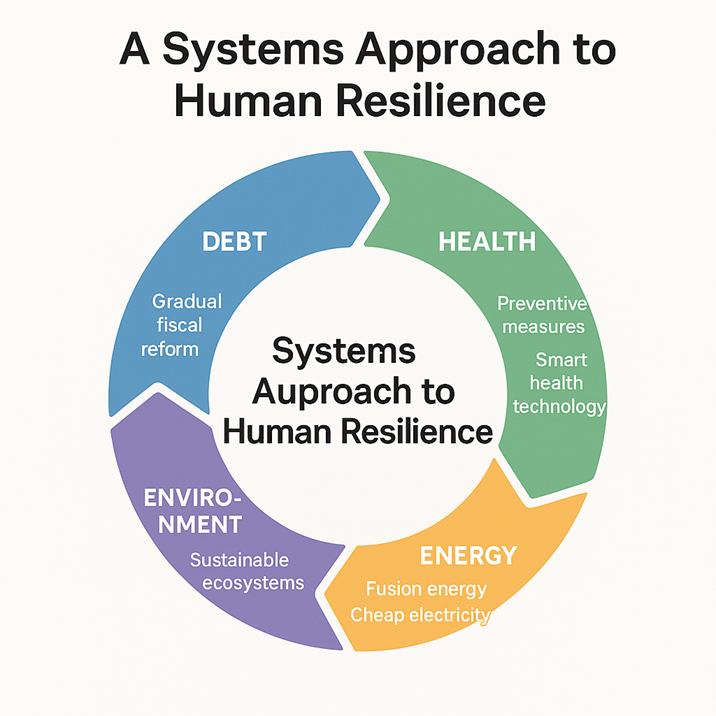
Rethinking Debt, Health, and Energy: A Systems Approach to Human Resilience Link to heading
In exploring the U.S. debt challenge, we examined how different strategies — from reshoring production to breakthrough technologies — could reshape fiscal sustainability. The conversation revealed that debt is not just a financial issue, but a systemic one, tied to health, energy, and human behavior.
Key Insights Link to heading
-
Debt and Imports
- Heavy reliance on imports worsens the U.S. trade deficit and debt trajectory.
- Gradual reshoring of critical industries (semiconductors, energy, defense) is the most effective path to reduce debt without triggering inflation or global retaliation.
-
Fusion Energy and Free Electricity
- A breakthrough like fusion energy could provide truly free electricity.
- This would lower industrial and household costs, boost GDP growth, reduce healthcare costs (via cleaner air), and cut defense spending tied to oil security.
- Debt-to-GDP could fall from ~122% today to ~95% by 2045.
-
Healthier Diets and Exercise
- Preventive health measures could reduce Medicare/Medicaid spending by 10–15% annually.
- A healthier workforce boosts productivity and tax revenues.
- Combined with fusion energy, debt-to-GDP could drop further to ~80–85% by 2045.
-
Smart Health Technology
- Devices like wearables, smart fridges, and connected scales can track vitals, recommend meals, and encourage exercise.
- Widespread adoption would shift healthcare from reactive treatment to proactive prevention.
- This reduces entitlement spending and strengthens resilience.
-
Systems Thinking
- Debt, health, energy, and environment are interconnected.
- Tackling them together creates positive feedback loops:
- Free energy → cheaper production → higher GDP → lower debt ratio.
- Smart health tech → preventive care → lower healthcare costs → debt stabilization.
- Healthy living → stronger workforce → higher revenues → fiscal relief.
Conclusion Link to heading
The path to resilience isn’t about fixing one domain in isolation. It’s about integrating debt reform, energy breakthroughs, healthier living, and smart technology into a unified strategy. By aligning short‑term incentives with long‑term survival, humanity can transform debt from a looming crisis into a manageable challenge — and ensure that existence is not just survival, but flourishing.